24300 Solon Road STE I, Bedford, OH 44146
Mon–Fri 8AM–5PM EST · After-Hours Support to 8PM

Wheeled racks with multiple horizontal storeys for storing furniture parts, boards, doors, and varnished components. Four series cover loads from 200 kg (B Series for moderate furniture parts) all the way to 2,250 kg (Quercus modular system for large heavy panels up to 6 meters long). Adjustable storey heights, easy-rolling castors, and configurations that stack inside one another when empty.
Whether you choose the lightweight B Series or the heavy-duty Quercus, three design principles run through every Jowi Mobile Rack — and explain why these racks stay in service for decades.
A few quick turns of a hexagon socket set screw adjusts the height of each storey. Want extra spacing for varnished doors to dry? Tight spacing for stacked drawer fronts? The same rack handles both. No proprietary tools, no service call — the operator reconfigures the rack to match the job.
Ball-bearing steering castors with convex tread move full loads through tight spaces with one hand. The convex tread reduces ground contact area for easier turning, and the ball bearings carry serious weight without binding. Even a fully loaded 500 kg C Series rack moves smoothly through a busy shop.
Fixed-frame racks stack inside one another when unloaded — five empty racks occupy the footprint of one. Length-adjustable models (Dabelju, X, XX, X3) collapse to a fraction of their working length using cam levers. Floor space taken by storage is space that pays itself back when it's not needed.
Each series is engineered for a specific weight class and material profile. The series letter indicates the upright type and rack dimensions; numbers in model codes indicate support tube length, upright count, and configuration.
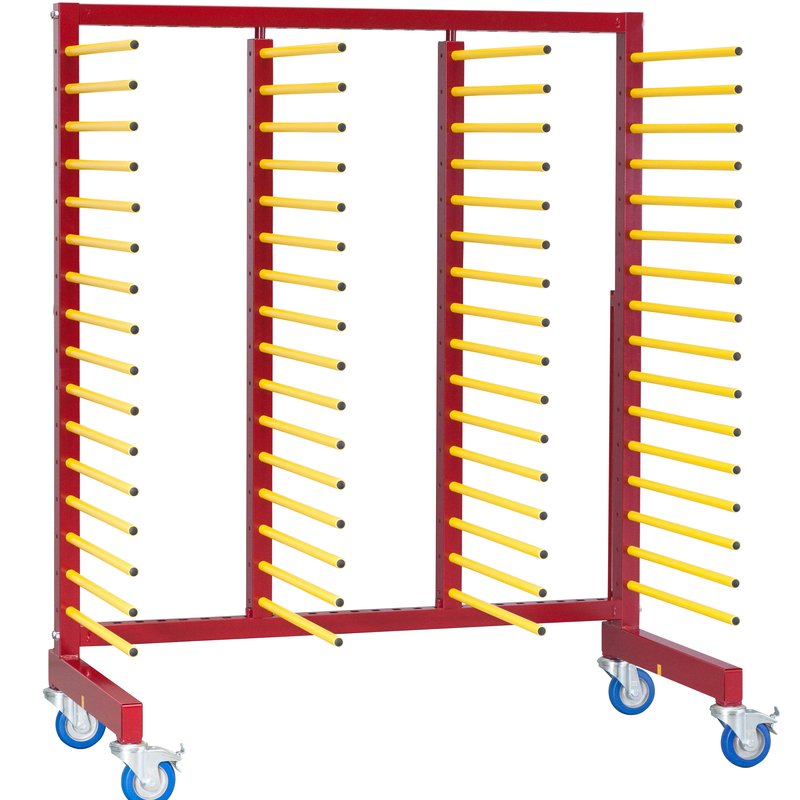
A tried and trusted design that's been a staple in cabinet shops and furniture manufacturers for years. The B Series handles cupboard doors, unit parts, and similar material with ease. C-series uprights with 16 pre-punched holes provide 66 mm storey height when all support tubes are used — perfect for stacking flat parts with consistent thickness.
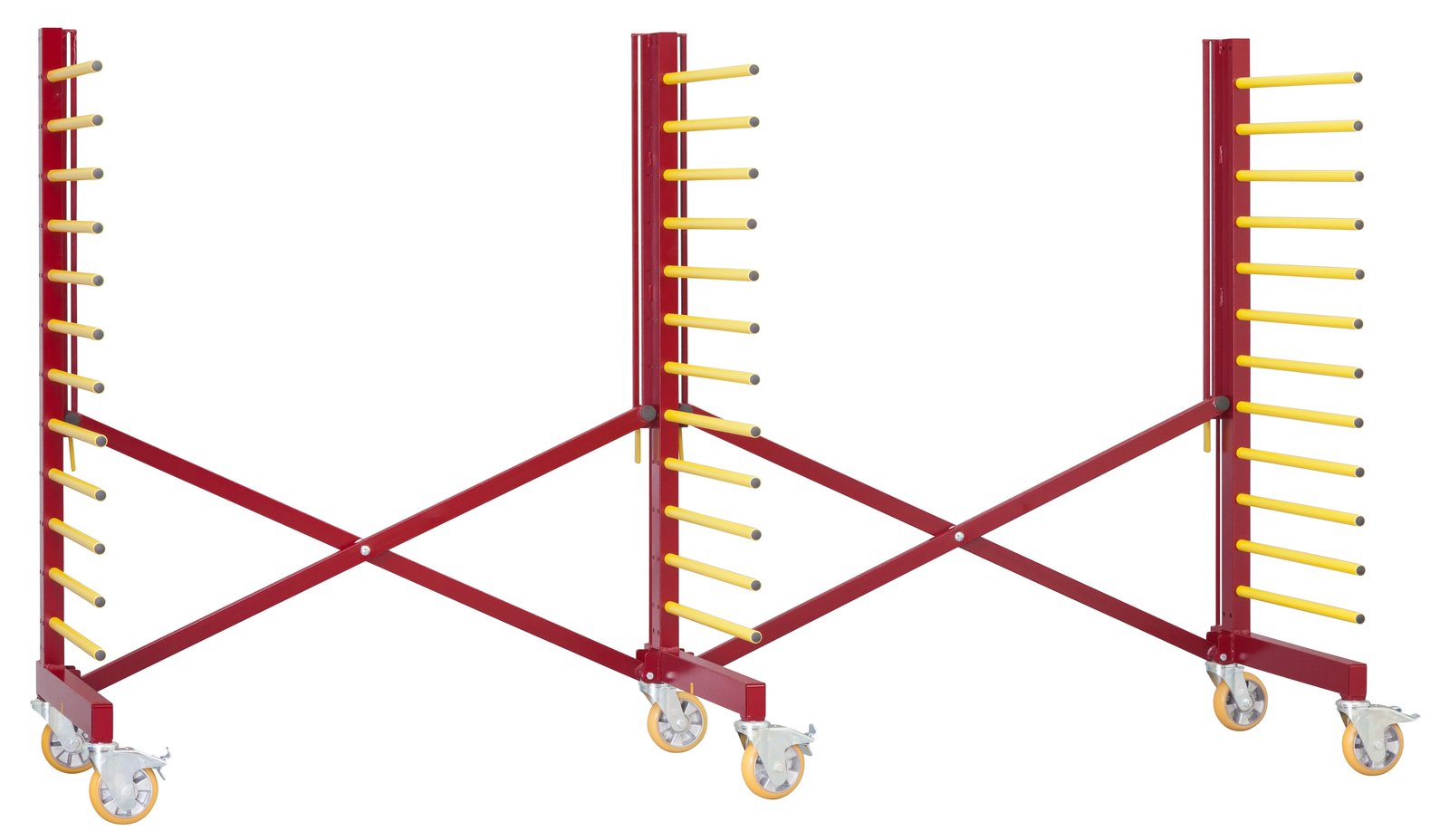
When the B Series isn't enough capacity, the C Series is the next step. Built to handle thicker components such as 50 mm boards, stair parts, and standard-sized doors. 12 pre-punched holes give 92 mm storey height when all tubes are used — wider spacing to accommodate the thicker material. Larger 160 mm castors handle the heavier loads.
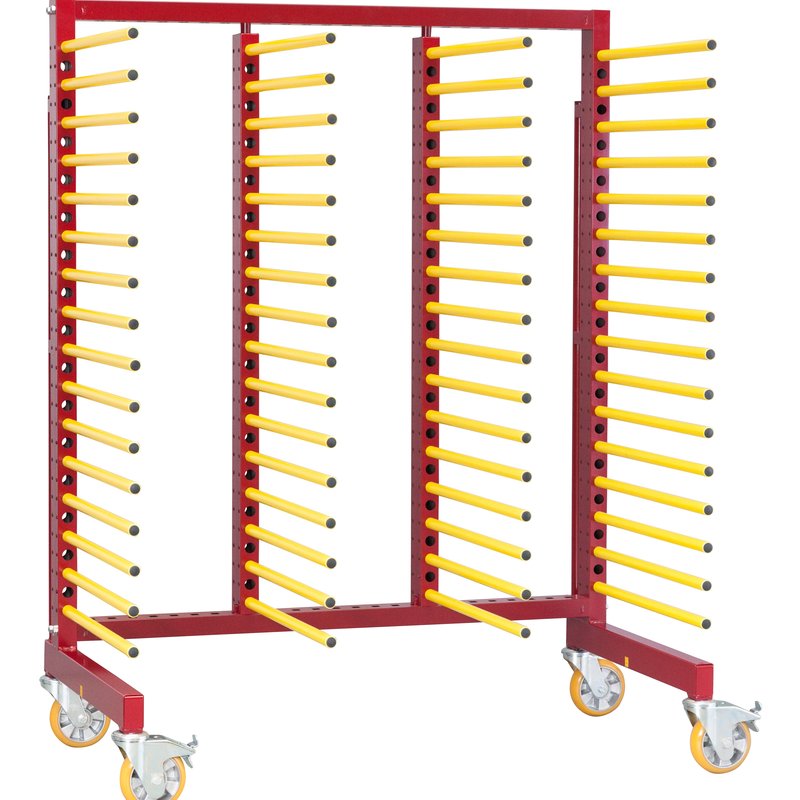
The most flexible Jowi solution for shops handling varying material shapes and sizes. Available in different depths with adjustable storey heights. Pre-punched with 31 support tube holes — far more granular control over how the rack is configured. Available in two standard versions: R660 (for furniture parts, higher capacity per storey) and R900 (for doors and wider material, more spacing).
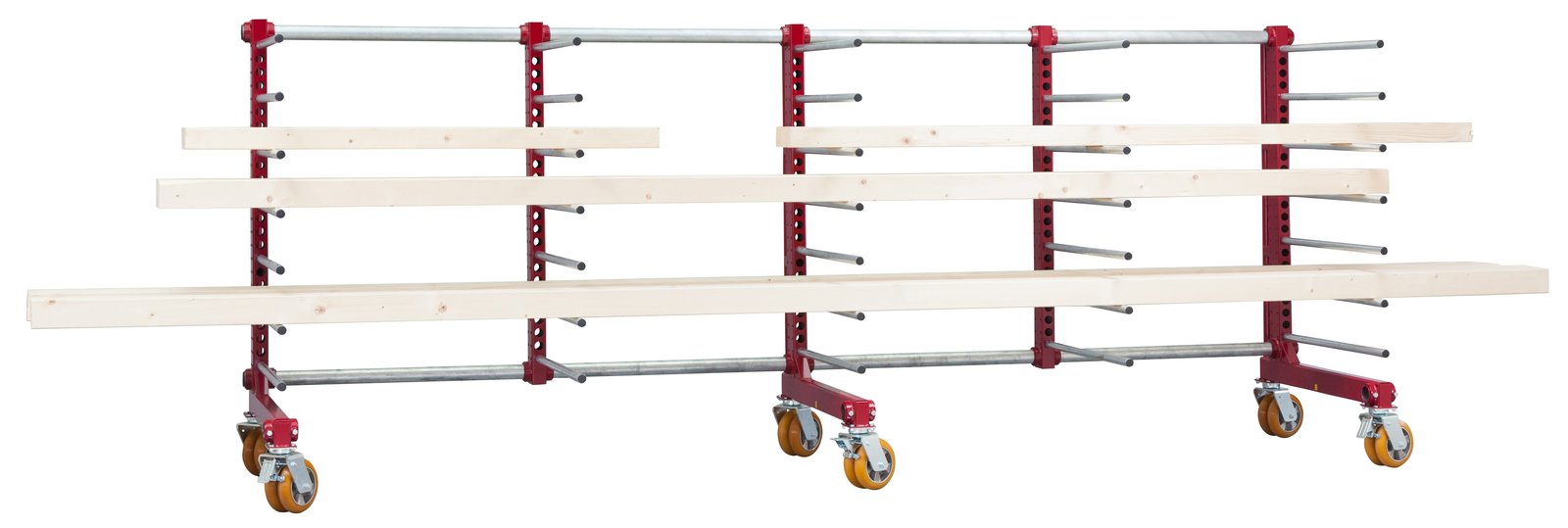
When the C and R series aren't enough, Quercus takes over. Designed for maximum stability with guaranteed mobility even fully loaded. Modular construction: L-shaped uprights with double castors connect via cross tubes; i-shaped uprights add anywhere along the length. Customizable up to 6 meters long. High-quality 200 mm double castors handle real shop floors with serious weight.
Note: A third cross tube is required if depth exceeds 880 mm OR rack length exceeds 3 m. Cross tubes are standard 2-inch galvanized threaded tubes (60.3 × 3.65 mm), available locally. Plastic caps for cross tube ends available as accessory.
Five questions guide the configuration decision. Walk through these and the right model becomes obvious.
Support tube length should roughly match the width of most frequently transported material. Larger boards can protrude up to one-third beyond the support tube (with load capacity reduced by one-third). Extension tubes are available for occasional oversized material.
Rule of thumb: material thickness + approximately 40 mm = compartment spacing. The 40 mm gap allows easy loading/unloading and air circulation for drying varnished components.
Different lengths → Choose a fixed-length model (e.g., B-2/2, C-2/2, R-2/2). Similar lengths → Choose a fully adjustable length model (X, XX, X3 variants). Custom lengths available in 55 cm intervals below 1,510 mm; standard custom lengths include 2,060, 2,335, and 2,995 mm for B, C, and R series.
For fixed-frame racks: reposition i-shaped uprights in the pre-punched holes (55 mm apart). For longer materials: couple two racks from the same series together — standard 0.3 m coupling, custom up to 1.5 m. Couplings are removable when the longer length isn't needed.
All load capacities assume even distribution and no impact loads. If only 2 of 4 support tubes are used per storey (e.g., for varnished parts that should touch minimally), spacers can be installed to increase storey load capacity. Quercus is the right answer when 500 kg per rack isn't enough.
Standard racks handle most needs. The accessories below address specific shop scenarios — oiled material, wall-mounted storage, multi-rack systems, and customization for unique production environments.
Fits over B, C, R, and Quercus support tubes (20–40 mm diameter). Minimal contact points with oiled material — faster drying, no visible marks from contact areas. Sold in 2 × 50 m rolls per unit.
Top and bottom rails (1,410 mm each, 1,510 mm including mounting bracket). For B, C, or R series i-shaped uprights. Rail spacing: 1,520 mm (R series) or 1,435 mm (B and C). Fastenings purchased separately based on wall type.
Connects two racks from the same series. Standard 0.3 m length, custom up to 1.5 m. Racks separate again when the longer combined length is no longer needed.
For occasional oversized material. UR23-0600 (Ø 27 mm steel with plastic cover) for B series; UR29-0600 (Ø 32 mm powder-coated) for C and R series. Both 600 mm long with 350 mm usable length.
Galvanized finish available on request. B series (Ø 23 mm): AR23-0590 or AR23-0780. C/R series (Ø 29 mm): AR29-0660, AR29-0770, AR29-0900, or AR29-1100.
Retrofit additional uprights to B, C, or R series fixed-frame racks. Order specifying upright type (B/C/R), number of support tubes needed, and required lengths.
Swivel castor that switches to fixed (straight-tracking) on demand. Available on request for B, C, R series. Cannot be retrofitted — must be ordered at time of purchase.
Telescopic, double-sided storage available on B, C, R series; standard on Dabelju-VV models. Cannot be retrofitted. Example (R660-2/2): standard 500 kg, T-chassis one side 300 kg, T-chassis both sides 400 kg total.
Specify RAL number at time of inquiry. Match your shop's brand colors or color-code racks by department/workflow.
For racks operating in heated environments (drying tunnels, finishing booths). Specify temperature range and maximum load capacity needed at time of inquiry.
Higher bottom edge available on request — allows robotic loading systems to reach beneath the lowest storey. Order at time of purchase.
Finishing caps for the exposed ends of Quercus cross tubes. Item: plastic caps GL 60. Improves appearance and protects against operator contact with raw tube ends.
We're Jowi's North American partner — direct factory access for custom configurations, common parts stocked in Bedford, Ohio, and the ability to spec exactly the rack series and accessories that fit your shop's workflow. Phone support Mon–Fri 8 AM – 5 PM EST, with after-hours support to 8 PM EST.
Custom colors, custom dimensions, heat-resistant variants, robotic-loading heights — specified directly with Jowi engineering.
Jowi racks are still in service decades after purchase. Replacement support tubes, castors, and parts available from NuTek inventory.
Common replacement parts and accessories stocked in Ohio for same-day shipment. Custom or specialty items expedited from Austria.
Phone support Mon–Fri 8 AM – 5 PM EST. After-hours support to 8 PM EST when your production can't wait.
Choosing between B, C, R, and Quercus comes down to load capacity, material width, and how much flexibility you need. Schedule a consultation and we'll walk through your shop's workflow to recommend the right series and configuration.